


Quantum computers fundamentally challenge today's cryptography. Many established cryptographic methods will lose their security in the long term. In order to continue protecting data in the future, it is crucial to understand the differences between classical cryptography, post-quantum cryptography (PQC), and quantum cryptography (QC).
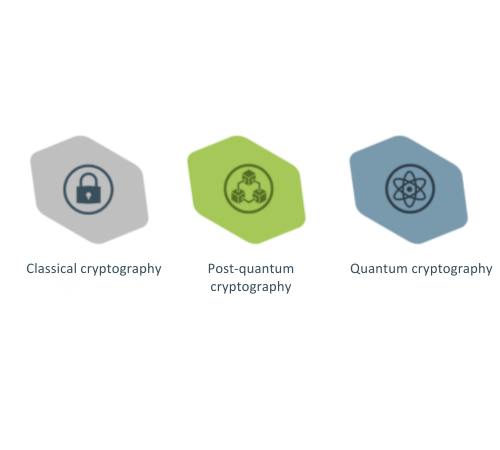
With the rapid development of quantum computers, cryptographic methods are facing new challenges, and cryptography itself is undergoing a fundamental shift. Quantum computers threaten many of the cryptographic techniques that are widely used today. To ensure data security in the future, it is important to understand the differences between classical cryptography, post-quantum cryptography (PQC), and quantum cryptography (QC).
Classical cryptography encompasses algorithms that were developed for conventional (classical) computers. Examples include block ciphers such as AES, asymmetric encryption schemes such as RSA, digital signature algorithms such as DSA, and hash functions such as SHA-256. All of these methods are widely deployed and form the foundation of today’s digital security.
As a result, these techniques are indispensable in modern IT environments and are used across a wide range of applications, for example, for transport encryption via TLS (https), for authentication through digital signatures, for protecting stored data and backups, and in blockchains to link individual blocks.
Classical cryptography is threatened by the capabilities of quantum computers, which enable more efficient attacks on classical cryptographic schemes through algorithms such as Shor’s and Grover’s. The underlying mathematical problems used by today’s asymmetric cryptographic methods can be solved efficiently by quantum computers. For symmetric cryptography, keys can be recovered significantly faster using brute-force search.
As a consequence, widely used asymmetric algorithms and protocols such as RSA or the Diffie-Hellman key exchange are considered broken in the presence of quantum adversaries and no longer provide adequate protection. Symmetric algorithms such as AES can also be decrypted much more efficiently using quantum computers and are therefore likewise at risk. This creates substantial security challenges for confidential data and digital communications. As a result, a new class of secure cryptographic algorithms is required: the methods of so-called post-quantum cryptography.
Post-quantum cryptography is a new approach that continues to rely on classical computers and algorithms, but is designed to be resistant to attacks from quantum computers. These algorithms are based on mathematical problems that remain difficult to solve even for quantum systems.
Unlike classical methods, post-quantum-safe asymmetric methods are not based on factorisation, the discrete logarithm or the Diffie-Hellman problem. Instead, they rely on alternative structures such as lattices and modules, hash-based constructions, or error-correcting codes.
As part of the NIST post-quantum cryptography standardisation process [1], several algorithms have already been standardised, including key-encapsulation mechanisms (ML-KEM FIPS 203, based on Kyber) and digital signature schemes (ML-DSA FIPS 204, based on Dilithium, and SLH-DSA FIPS 205, based on SPHINCS+).
These standards already provide a practical foundation for implementing post-quantum cryptography today and will be extended further through additional standardisation efforts in the future.
In contrast to post-quantum cryptography, quantum cryptography relies directly on physical principles of quantum mechanics to provide security guarantees. The most well-known application is quantum key distribution (QKD). As described in protocols such as BB84, this form of key exchange not only enables secure key distribution but can also detect eavesdropping attempts.
In addition, quantum circuits address challenges related to random number generation, enabling the implementation of true random number generators (TRNGs) using relatively simple quantum operations. In classical computers, generating high-quality random bits remains a resource-intensive task and is therefore often replaced by the use of pseudo-random number generators (PRNGs).
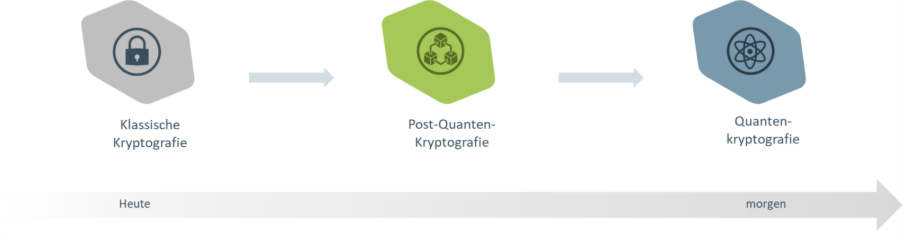
Quantum cryptography thus promises significant long-term benefits for security. However, it will only become practically viable once quantum computers or quantum chips are widely available. Once this level of adoption is reached, a combination of post-quantum cryptography and quantum cryptography is likely to be used in practice. In the current transition phase, post-quantum cryptographic methods are expected to play the dominant role, while classical cryptography will gradually lose relevance due to its vulnerability to quantum attacks.
[1] https://csrc.nist.gov/projects/post-quantum-cryptography

FortIT enables secure digital business, supporting companies with innovative digitalization projects and strategic initiatives. With deep expertise in modern technologies, FortIT delivers fast, visible results and lasting impact.


